


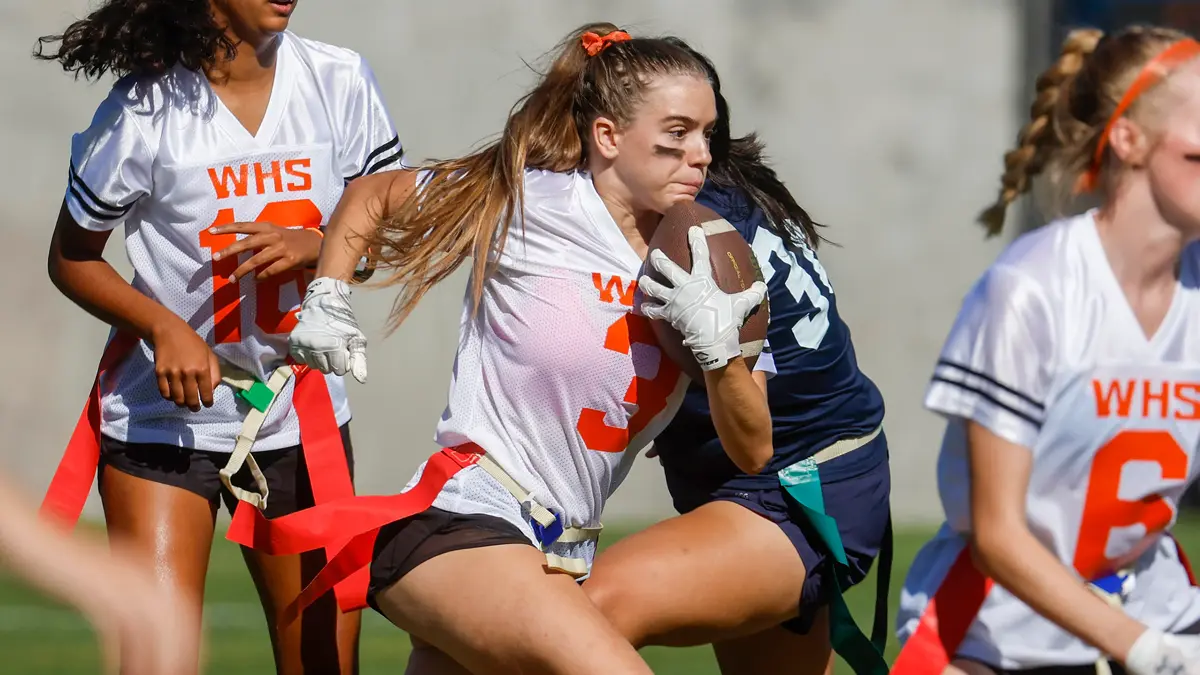
High school flag football is evolving to look more like the traditional tackle game. The NFHS Flag Football Rules Committee has approved eight major rule changes for the 2026–27 season. The most exciting update is a new “onside kick” equivalent that gives trailing teams a chance to keep the ball after scoring.
These changes reflect a sport that is growing fast. Nearly 69,000 girls now compete in flag football across 2,700 schools nationwide. More states move toward sanctioning the sport every year.
The New “Onside Kick” Rule
The headline change addresses the final moments of a game. In tackle football, trailing teams use an onside kick to regain possession. Flag football now has its own version under an exception to Rule 8-3-9.
A team that is behind in the score can now choose to keep the ball after a try. If they pick this option, they start at fourth down on their own 20-yard line. This setup creates a high-risk, high-reward play without the physical contact of a traditional kick.
Tyler Cerimeli, chair of the committee, believes this adds a vital strategic layer. “This will allow a trailing team to run a high-risk play to facilitate a potential comeback,” Cerimeli said.
Safety Restarts and Field Sizes
The committee also updated what happens after a safety. Starting in 2026–27, the team that gave up the safety must put the ball in play with a scrimmage kick from their own 20-yard line. This aligns flag football with the tackle version and rewards the team that forced the safety with better field position.
Additionally, state associations now have a fourth approved field size: 300 by 160 feet. This gives schools more flexibility to fit sanctioned play into existing facilities.
Roster Minimums and Fair Play
Several other revisions will improve the flow and safety of the game:
- Minimum Roster: Teams still need seven players to start. However, if injuries or disqualifications occur, a team can now continue with as few as five players.
- Defining “Hurdling”: The rules now officially define hurdling to ensure consistent enforcement of illegal contact fouls.
- More Timeouts: Coaches now have three timeouts per half instead of two. This helps with clock management and player safety.
- Ball-Stripping: Rule 9-7-4 now explicitly forbids batting, stripping, or punching the ball out of a player’s hands.
A Rapidly Growing Sport
Flag football is booming. Seventeen states have already sanctioned girls’ flag football. Six more states, including North Carolina and New Jersey, will vote on sanctioning in 2026. This national expansion shows that flag football is no longer just a pilot program; it is a mainstream interscholastic sport.